paving
Block paving
£50 to £120 per square metre installed is the 2026 range for block paving, concrete blocks at the cheap end and stone setts at the dear end. Sixty square metres in concrete blocks runs £4,500 to £6,000, rising to £5,500 to £7,500 for composite.
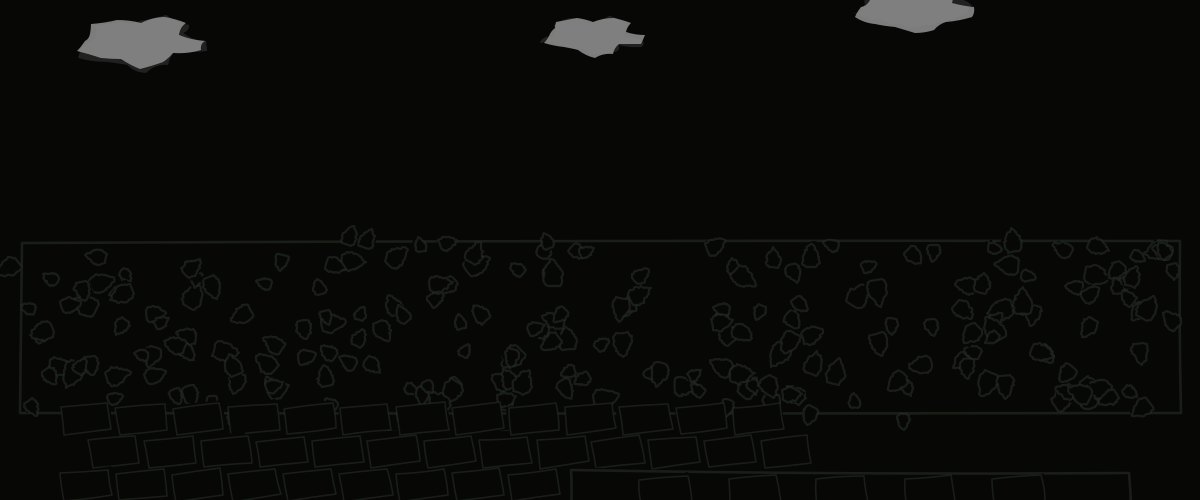
What this covers
What it costs. £4,500 to £6,000 covers a 60 square metre concrete block driveway in 2026, with £50 to £120 per square metre spanning the material choices. Full cost breakdown.
What the job covers
- Excavating to depth and laying the sub-base
- Laying blocks to a chosen pattern
- Cutting in around edges and manholes
- Edge restraints haunched in concrete
- Jointing sand, compaction and the later top-up
Worth knowing
Scotland has no five square metre threshold. A hard surface between the house and a road must be porous, or run off to a porous area inside the property, whatever its size.
Scottish Government planning circular 1/2024, Class 3C
What is involved
Block paving holds together by friction. Mortar plays no part between the blocks; each one is wedged by kiln dried sand in 2mm to 5mm joints and locked at the perimeter by haunched edging. Take the edge restraint away and the field of blocks creeps outwards under braking and steering until the joints gape. Edging kerbs cost £5 to £10 per linear metre, and they are the component stopping an entire surface from unravelling.
The laying course is 30mm to 40mm of sharp sand, screeded to a consistent thickness and never used to correct dips in the stone below. Screed sand deeper into a hollow and the blocks above will sink as traffic consolidates it. Underneath sits 150mm to 200mm of MOT Type 1 on a driveway, compacted in 75mm lifts, over a geotextile membrane wherever the subgrade is clay. Blocks go down onto an untrodden screed, get cut in at the edges last, then vibrated with a plate compactor wearing a rubber sole plate.
Jointing sand goes in twice. One brush-in with vibration, then a second pass a week later once traffic has settled the first lot, because half filled joints are how blocks start to rock. Falls run 1 in 60 to 1 in 80 towards a channel drain, a border or a permeable strip, and any drive shedding water at the house wants a threshold drain across the garage line. Permeable blocks work differently again: wider joints and a clean angular sub-base take rainfall through the surface, which keeps a front driveway outside the English planning threshold at any size.
Choosing someone for the job
Edge restraint: ask whether kerbs are haunched in concrete on both sides. Sub-base: ask for the Type 1 depth, 150mm as a minimum on a driveway. Screed: ask what the laying course is and how thick it goes. Jointing sand: ask whether a second pass goes in a week after laying. Permeable blocks: ask whether they are specified and what sub-base goes with them.
Common questions
How long does block paving last?
Twenty five years and beyond where the sub-base was built properly. Individual blocks lift and swap out, which is the practical advantage over tarmac and concrete. Sinkage nearly always traces back to the sub-base or the screed rather than the blocks themselves.
Why has my block paving sunk in patches?
Consolidation of a screed laid too thick, or a sub-base never compacted in layers. Water tracking under the edging washes fines out and produces the same dip. Putting it right means lifting the blocks, rebuilding the base locally and relaying, not topping up the sand.